
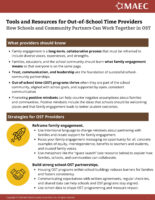
Download: How Schools and Community Partners Can Work Together in OST
MAEC’s Tools and Resources for Out-of-School Time Providers of one-page resources brings together practical strategies and lessons from OST practitioners and experts. The series covers topics including program quality and equity, family engagement, mental wellness, positive youth development, and school-community partnerships. Each resource summarizes key takeaways, actionable strategies, and additional resources to support OST providers in their work with youth and families. See also:
- Ensuring Program Quality & Equity in OST
- Amplifying Family Voice in OST
- Mental Health & Trauma Supports
- Positive Behavioral Interventions and Supports (PBIS)
How Schools and Community Partners Can Work Together in OST
What providers should know
- Family engagement is a long-term, collaborative process that must be reframed to include diverse voices, experiences, and strengths.
- Families, educators, and the school community should learn what family engagement means so that everyone is on the same page.
- Trust, communication, and leadership are the foundation of successful school-community partnerships.
- Out-of-school time (OST) programs thrive when they are part of the school community, aligned with school goals, and supported by open, consistent communication
- Promoting positive mindsets can help counter negative assumptions about families and communities. Positive mindsets include the ideas that schools should be welcoming places and that family engagement leads to better student outcomes.
Strategies for OST providers
Reframe family engagement.
- Use intentional language to change mindsets about partnering with families and create support for family engagement.
- Focus your family engagement messaging on opportunity for all, concrete examples of equity, interdependence, benefits to teachers and students, and trusted family voices.
- Use metaphors like the “space launch” (see resource below) to explain how families, schools, and communities can collaborate.
Build strong school-OST partnerships.
- Housing OST programs within school buildings reduces barriers for families and fosters consistency.
- Communicating expectations with written agreements, regular check-ins, and shared data can help schools and OST programs stay aligned.
- Use school data to shape OST programming and measure impact.
Foster trust with families and staff.
- Build relationships with families early and often through positive touch points before problems arise.
- Be visible, consistent, and authentic with families by greeting them, learning their names, and communicating in their preferred languages.
- Own any mistakes made and validate family concerns when trust is broken. Repair relationships through honesty, empathy, and follow-through.
- Recognize that trust-building with families is a long game, especially for working through past negative experiences they may have had in schools or OST programs.
Resources
- Reframing the Conversation around Family and Community Engagement (NAFSCE): https://nafsce.org/page/ReframingtheConversation
This content was informed by MAEC’s “Complementing the School Day: Tools and Resources for OST Providers” webinar series.
The fifth session was titled “It Takes a Village: How Schools and Community Partners Can Work Together in OST” facilitated by Sherri Wilson from NAFSCE, Demond Troy from Achieve Tutoring, and Trina Wilson from Springhill Lake Elementary School. This session focused on reframing family engagement and showcasing a real-world example of a successful school-community partnership in OST.
