
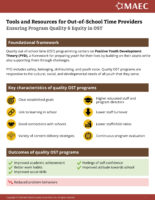
Download: Ensuring Program Quality & Equity in OST
MAEC’s Tools and Resources for Out-of-School Time Providers of one-page resources brings together practical strategies and lessons from OST practitioners and experts. The series covers topics including program quality and equity, family engagement, mental wellness, positive youth development, and school-community partnerships. Each resource summarizes key takeaways, actionable strategies, and additional resources to support OST providers in their work with youth and families. See also:
- Amplifying Family Voice in OST
- Mental Health & Trauma Supports
- Positive Behavioral Interventions and Supports (PBIS)
- How School and Community Partners Can Work Together in OST
Ensuring Program Quality & Equity in OST
Foundational framework
Quality out-of-school time (OST) programming centers on Positive Youth Development Theory (PYD), a framework for preparing youth for their lives by building on their assets while also supporting them through challenges.
PYD includes safety, belonging, skill-building, and youth voice. Quality OST programs are responsive to the cultural, social, and developmental needs of all youth that they serve.
Key characteristics of quality OST programs
- Clear established goals
- Link to learning in school
- Good connections with schools
- Variety of content delivery strategies
- Higher educated staff and program directors
- Lower staff turnover
- Lower staff/child ratios
- Continuous program evaluation
Outcomes of quality OST programs
- Improved academic achievement
- Better work habits
- Improved social skills
- Feelings of self-confidence
- Improved attitude towards school
- Reduced problem behaviors
Strategies for OST providers
Use data to drive improvement.
- Collect feedback from youth, families, and staff to inform continuous improvement.
- Regularly use evaluation tools like the Assessment of Program Practices Tool (APT), Youth Program Quality Assessment (YPQA), or Dimensions of Success (DOS) to assess program quality over time.
Center youth voice and choice.
- Create leadership opportunities and co-design activities with youth.
- Move beyond participation to shared decision-making.
- Build staff capacity.
- Encourage reflection, collaboration, and culturally responsive practices.
- Train staff on facilitation vs. supervision.
Resources
- Collaborative for Academic, Social, and Emotional Learning (CASEL) Framework: www.casel.org
- National Institute on Out-of-School Time (NIOST) Tools & Publications: https://niost.org
This content was informed by MAEC’s “Complementing the School Day: Tools and Resources for OST Providers” webinar series.
The first session was titled “Keeping the Momentum: Ensuring Program Quality & Equity in OST,” facilitated by Georgia Hall from the National Institute on Out-of-School Time (NIOST). This session focused on defining and measuring quality in OST programs through a lens of positive youth development.
