

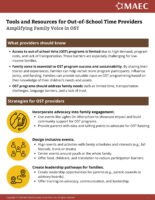
Download: Amplifying Family Voice in OST
MAEC’s Tools and Resources for Out-of-School Time Providers of one-page resources brings together practical strategies and lessons from OST practitioners and experts. The series covers topics including program quality and equity, family engagement, mental wellness, positive youth development, and school-community partnerships. Each resource summarizes key takeaways, actionable strategies, and additional resources to support OST providers in their work with youth and families. See also:
- Ensuring Program Quality & Equity in OST
- Mental Health & Trauma Supports
- Positive Behavioral Interventions and Supports (PBIS)
- How School and Community Partners Can Work Together in OST
Amplifying Family Voice in OST
What providers should know
- Access to out-of-school time (OST) programs is limited due to high demand, program costs, and lack of transportation. These barriers are especially challenging for low-income families.
- Family voice is essential to OST program success and sustainability. By sharing their stories and experiences, families can help recruit more program participants, influence policy, and funding. Families can provide valuable input on OST programming based on their knowledge of their children’s needs and assets.
- OST programs should address family needs such as limited time, transportation challenges, language barriers, and a lack of trust.
Strategies for OST providers
Incorporate advocacy into family engagement.
- Use events like Lights On Afterschool to showcase impact and build community support for OST programs.
- Provide parents with data and talking points to advocate for OST funding.
Design inclusive events.
- Align events and activities with family schedules and interests (e.g., fall festivals, trunk-or-treats).
- Center events around youth or the whole family.
- Offer food, childcare, and translation to reduce participation barriers.
Create leadership pathways for families.
- Create leadership opportunities for parents (e.g., parent councils or advisory boards).
- Offer training on advocacy, communication, and leadership.
Build relationships year-round.
- Use social media, newsletters, texts, and informal check-ins to stay connected.
- Don’t limit communication to behavior issues or mandatory events.
Resources
- Afterschool Alliance: afterschoolalliance.org
- Lights On Afterschool: afterschoolalliance.org/loa.cfm
This content was informed by MAEC’s “Complementing the School Day: Tools and Resources for OST Providers” webinar series.
The second session was titled “Beyond a Seat at the Table: Amplifying Family Voice in OST,” facilitated by Tiyana Glenn from the Afterschool Alliance. This session focused on strategies for engaging families in OST programs and empowering them as advocates.
